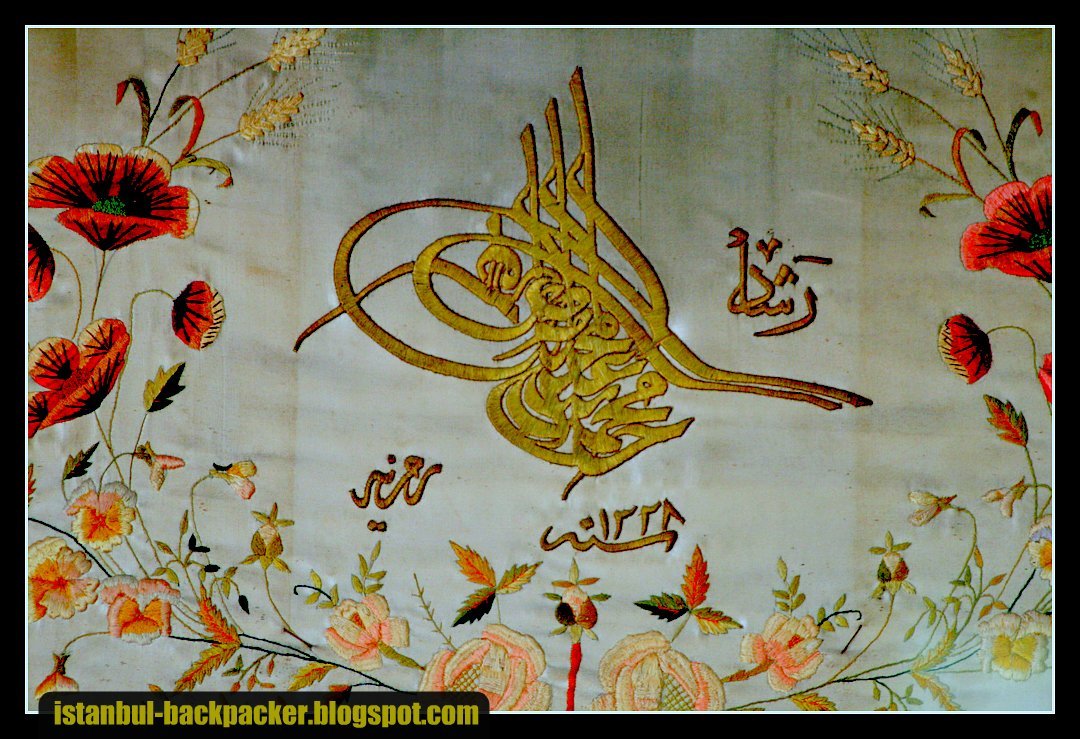
Tughra: The Sultan's Seal

Tuğra: Seal of Sultans

A tughra is a calligraphic seal or signature of an Ottoman sultan that was affixed to all official documents and correspondence. It was also carved on his seal and stamped on the coins minted during his reign.


The tughra was designed at the beginning of the sultan's reign and drawn by the court calligrapher on written documents. The first tughra belonged to Orhan I (1284-1359), the second ruler of the Ottoman Empire and it evolved until it reached the classical form in the tughra of Sultan Suleiman the Magnificent (1494-1596).

Tughras served a purpose similar to the cartouche in ancient Egypt or the Royal Cypher of British monarchs. Every Ottoman sultan had his own individual tughra. The picture of embroidery dated 1912 above shows tughra of Sultan Mehmed Reşad V, embroided with golden thread.

Popular posts from this blog

Antique fine porcelaine plate with drawing: Acropolis

Antique fine porcelaine plate with drawing: ACROPOLIS, PATENT D W, with motto stamp "DIEU ET MON DROIT, HONI SOIT QUI MAL Y PENSE", by "C.L.A.Q. BRO"

Is this an ancient Anatolian Celtic crown?

Turkish Zarf & Russian Podstakannik A Turkish zarf is a holder, usually of ornamental metal, for a coffee cup without a handle. Coffee was served in small cups without handles, which were placed in holders known as zarf to protect the cup and also the fingers of the drinker from the hot fluid in Ottoman times. Cups were typically made of porcelain. However since it was the holder that was more visible, it was typically more heavily ornamented. A Russian podstakannik is a tea glass holder, most commonly made of metal with a handle. It is a traditional way of serving and drinking tea in Russia, Ukraine and Belarus.