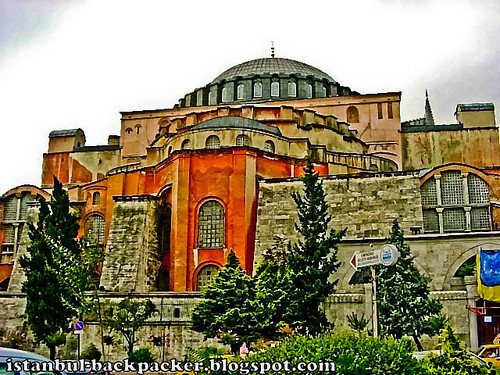
Hagia Sophia Seismic Retrofit in 16th Century

Hagia Sophia

Hagia Sophia started showing signs of fatigue in 16th century. The building was extensively strengthened with the addition of structural supports to its exterior by the Ottoman architect Sinan, considered one of the world's first earthquake engineering and seismic retrofit projects. You can see the brown exterior columns of reinforcement structure supporting the orange-pink Hagia Sophia in the picture.

Hagia Sophia, originally uploaded by voyageAnatolia.

Popular posts from this blog

Tughra: The Sultan's Seal

A tughra is a calligraphic seal or signature of an Ottoman sultan that was affixed to all official documents and correspondence. It was also carved on his seal and stamped on the coins minted during his reign.

Antique fine porcelaine plate with drawing: Acropolis

Antique fine porcelaine plate with drawing: ACROPOLIS, PATENT D W, with motto stamp "DIEU ET MON DROIT, HONI SOIT QUI MAL Y PENSE", by "C.L.A.Q. BRO"

Is this an ancient Anatolian Celtic crown?

Turkish Zarf & Russian Podstakannik A Turkish zarf is a holder, usually of ornamental metal, for a coffee cup without a handle. Coffee was served in small cups without handles, which were placed in holders known as zarf to protect the cup and also the fingers of the drinker from the hot fluid in Ottoman times. Cups were typically made of porcelain. However since it was the holder that was more visible, it was typically more heavily ornamented. A Russian podstakannik is a tea glass holder, most commonly made of metal with a handle. It is a traditional way of serving and drinking tea in Russia, Ukraine and Belarus.